The Imagination Station Headquarters!

Sunday, March 22, 2020
New home for the Imagination Station
Due to the Corona Virus, the PS 23 Imagination Station will be operating from my home. The students will continue to receive lessons on Google Classroom. I will use this blog as my classroom "closet"of sorts. I'll leave miscellaneous articles, videos and links for extra inspiration. Everyone stay safe out there and keep creating!

Tuesday, December 22, 2015

Wow, the year is flying by! Already the New Year for civilians. For teachers it begins in September and ends in June!
Here are a few pics of the mural that I have been working on with select 4th-5th Graders. I chose the theme of Keith Haring, and the kids and I brainstormed ideas of how to add elements of the art studio into the full mural! They did a fantastic job, working endless hours and always up for the challenge and touchups!
This is the fourth mural that I have been fortunate to receive permission for. The next mural will be themed around the Library in some way, though Im really not even sure what it will look like yet!!
As always, thanks for looking! Happy Holidays to you and your family, Brian
Tuesday, October 27, 2015
2nd Grade: Observational drawing/Intro to Landscape


Next we ventured outside to a great tree in our backyard for observational drawing. Again the emphasis of this lesson was on line work and using shading to show volume in the trunk and limbs.
We ended this unit with a intro to landscape. We again used a horizon line to separate land from sky. Then the students used pencil to sketch a tree as we had done previously outside. They were also shown how to create space by making the trees appear smaller as they ascended up the landscape composition. Phewwww, that was a mouthful. Enjoy all and good luck with your students or children!!
Tuesday, October 20, 2015
Representational Art: Line and Shape to create Cityscapes with Space!


Tuesday, October 6, 2015
Manipulate This...Paper Sculpture 1st Gra


The students began with a demo on how to manipulate the strips into straight, zigzag, curved and wavy lines. Next came folding and attaching shapes such as circles, squares and triangles. These were all shapes and lines that we worked with last year, so just a good refresher.
They began by working in small groups collabortively, the ones that struggled had additional help from other stronger students. Next period they colored to create patterns on individual oaktag. They did have pattern examples on their tables that I provided.
Finally the students attacked their own sculptures after a quick smart board lesson on Day 3. Honestly I just googled 'Line and Shape Sculptures' and we had discussion of similarities and differences with their own attempts.
The ones who finished early had the time to apply torn pieces on top of the paper strips to create a bit more detail. Sure made them feel accomplished out the gate for the school year!!
*The attached picture is a handout I recieved at a Blueprints for the Arts workshop I attended with NYCDOE (these workshops are great, and freeeee!!!). It shows how this and many other activities in the Visual Arts align with the Standards for Mathematical Practice (COMMON CORE, yikes).These are our ammunition when asked why the Arts are relevant in kids school days...another words why they should pay you to teach it.
Tuesday, September 29, 2015
Well, its good to be back.
I had around thirty posts 2 years ago and was fortunate to have a bunch of page views. Soooo, people either liked it or not, but they were looking!
Here I am teaching elementary art for the twelfth year in the same room at the same school. I came in this year and everything looked dull and unexciting as I unpacked materials and moved furniture. This made me gloomy, so I'm sure kids are not going to feel any happier about it.
One solution? Paint lots of furniture and old boards lots of bright colors and give it new life!
It felt better and a few teachers noticed the color brightness as well!
I am certainly looking to challenge myself this year with new projects, bulletin boards and materials. This will surly lead to some failure, but learning from these experiences are how I grow as an art teacher professionally and mentally.
Anyway, I hope to be posting new projects this year. I will probably get around to 2-3 projects a month, all of which will be PK-2nd. The Dance teacher was given the upper grades, so It'll be the little ones for me.
Thanks for checking out this return blog, I hope to share with you successes and utter defeats as I give another year of elementary art curriculum!


I had around thirty posts 2 years ago and was fortunate to have a bunch of page views. Soooo, people either liked it or not, but they were looking!
Here I am teaching elementary art for the twelfth year in the same room at the same school. I came in this year and everything looked dull and unexciting as I unpacked materials and moved furniture. This made me gloomy, so I'm sure kids are not going to feel any happier about it.
One solution? Paint lots of furniture and old boards lots of bright colors and give it new life!
It felt better and a few teachers noticed the color brightness as well!
I am certainly looking to challenge myself this year with new projects, bulletin boards and materials. This will surly lead to some failure, but learning from these experiences are how I grow as an art teacher professionally and mentally.
Anyway, I hope to be posting new projects this year. I will probably get around to 2-3 projects a month, all of which will be PK-2nd. The Dance teacher was given the upper grades, so It'll be the little ones for me.
Thanks for checking out this return blog, I hope to share with you successes and utter defeats as I give another year of elementary art curriculum!


Tuesday, November 25, 2014
1st Grade: Color Unit
For the month of November, my first graders have been learning about colors. We began with the Color Wheel, describing how it is useful for artists. The Color Wheel helps us identify secondary colors (orange, purple and green) that are between the Primary Colors (red, blue, yellow). This is the main focus as the next lesson is about mixing the Primary Colors on a plate! The students also learned how the color wheel can show us complementary colors which are opposite of one another on the wheel, and warm/cool colors.
For the first lesson, they traced a circle and used a ruler to make six pieces of pie. I had examples at each table so that the colors were added correctly. They also were asked to write "The Color Wheel", "Primary" and "Secondary" with the colors being identified. Hopefully some of this will stick in their artistic memory!
The next lesson is about color mixing. They have had a lesson already about basic paint procedure and brush cleaning. I put the 3 Primary colors in a triangle and basically ask that the secondary colors are mixed between them. They need to be given a demo, certainly emphasizing the need to keep some of the primary colors left for the painting! Once completed, the plate should look like a color wheel, with the Primary/Secondary pattern all the way around!! They love this and seem to understand once the plate and color wheel are shown side by side.
For the third lesson, we discuss the artist Piet Mondrian with his wonderful abstract artwork. The students are shown how he used different placement of black lines. They are introduced to Vertical, Horizontal and Diagonal. They are each given 5 1" strips of black construction paper and asked to arrange them to create large shapes. Next, I passed out Primary colored oil pastels, and suggested to color in several shapes. This is a good lesson as it covers math concepts and color elements in one short period! Sure hope you enjoy and be sure to encourage discovery with your young ones as well!
Mac


For the first lesson, they traced a circle and used a ruler to make six pieces of pie. I had examples at each table so that the colors were added correctly. They also were asked to write "The Color Wheel", "Primary" and "Secondary" with the colors being identified. Hopefully some of this will stick in their artistic memory!
The next lesson is about color mixing. They have had a lesson already about basic paint procedure and brush cleaning. I put the 3 Primary colors in a triangle and basically ask that the secondary colors are mixed between them. They need to be given a demo, certainly emphasizing the need to keep some of the primary colors left for the painting! Once completed, the plate should look like a color wheel, with the Primary/Secondary pattern all the way around!! They love this and seem to understand once the plate and color wheel are shown side by side.
For the third lesson, we discuss the artist Piet Mondrian with his wonderful abstract artwork. The students are shown how he used different placement of black lines. They are introduced to Vertical, Horizontal and Diagonal. They are each given 5 1" strips of black construction paper and asked to arrange them to create large shapes. Next, I passed out Primary colored oil pastels, and suggested to color in several shapes. This is a good lesson as it covers math concepts and color elements in one short period! Sure hope you enjoy and be sure to encourage discovery with your young ones as well!
Mac
Tuesday, November 18, 2014
3rd Grade: Keith Haring inspired Display
For this year, I have been offered to teach all of the 3rd Graders! Great, but only once a week! Scheduling is super tough for any art teacher, and you begin to plan accordingly to certain classes.
I decided that I would teach the elements and principles to the students by studying one artist a month or for 4 periods. During the month of October, we looked at the compositional elements of line, color, pattern and figure of Keith Haring. The students were shown his work on the smartboard and we discussed his subject matter and line work. Next they were able to spend time on small reproductions of his work with index cards. They loved using the bold colors and strong line work!
Next, they were able to trace, cut and attach 2 figueres together to make a 3/D standing figure like one of Harings. The figures were decorated using line, shape and pattern. This was a fun way to introduce a simple sculpture method, one that they would be able to try at home with any object they chose to create! They really enjoyed working with this artist and were excited that he was a local NYC artist!


I decided that I would teach the elements and principles to the students by studying one artist a month or for 4 periods. During the month of October, we looked at the compositional elements of line, color, pattern and figure of Keith Haring. The students were shown his work on the smartboard and we discussed his subject matter and line work. Next they were able to spend time on small reproductions of his work with index cards. They loved using the bold colors and strong line work!
Next, they were able to trace, cut and attach 2 figueres together to make a 3/D standing figure like one of Harings. The figures were decorated using line, shape and pattern. This was a fun way to introduce a simple sculpture method, one that they would be able to try at home with any object they chose to create! They really enjoyed working with this artist and were excited that he was a local NYC artist!
Tuesday, October 21, 2014
Kinder, 2nd, 5th Books...A little more challenge each year!
At the start of this year, I challenged the students with a few bookmaking skills. The Kindergarten and Pre- K are learning about shape names and how to with both straight and curved lines! Trust me, most of them do not come in here with this knowledge!! But very soon, it just unlocks and they catch up with the shapes! They spent time with coloring and cutting skills with shapes, then used those to create a accordian book!
The 2nd Graders were using their memory to think of a special moment that they experienced during the summer. They had 4 pages in their diamond books to illustrate that story!
The 5th Graders were introduced to the abstract work of Piet Mondrian. We looked at his grey composition with primary colored squares popping up. This was a perfect chance to make some Mondrian Pop up Books!!
Enjoy!


The 2nd Graders were using their memory to think of a special moment that they experienced during the summer. They had 4 pages in their diamond books to illustrate that story!
The 5th Graders were introduced to the abstract work of Piet Mondrian. We looked at his grey composition with primary colored squares popping up. This was a perfect chance to make some Mondrian Pop up Books!!
Enjoy!
1st Grade: Representational Art: City Scape Drawings and Collage
For these two lessons, the students were introduced to Cityscape. We began with reading the book Tar Beach and looking at how the city is depicted with shapes. The students were shown that buildings close to the us appeared to have the largest windows. We then noticed that buildings that were overlapped appeared further away with smaller windows. The buildings that were behind all others were the farthest distance requiring nothing more than dots or slashes. This is an introductory lesson to space and use of shape! The students have now been introduced to Abstract and Representational art, and are able to recognize that the artist is arranging shapes and lines in a thoughtful and intentional way!!


Tuesday, October 14, 2014
2nd Grade: Intro to Crayon Resist and Non-Representational Art
For this Second Grade lesson, the students created two projects using crayon resist. The first was how to create block lettering for their names. I showed them in a demo of writing your name with a pencil large enough to take up most of a 6x18" white paper. Next, they took a crayon and outlined 1/2" all the way around the pencil line. They decorated with various patterns that were demonstrated with crayons. Then they put that project down.
The second crayon resist project was an introduction to non-representational art (abstract). We talked about how the various artists (Paul Klee, Kandinsky) created designs by overlapping and arranging the element of Shape and Line. The students traced and overlapped various shapes to make a design. I encouraged them to turn it upside down and rotate the artwork until they were satisfied with the composition.
The last class we added the wash. Pretty basic, just half a cup of water with a few drops of tempura paint! This was a good starter as the students were able to combine technical skills with imaginative elements for their final products! Enjoy!


The second crayon resist project was an introduction to non-representational art (abstract). We talked about how the various artists (Paul Klee, Kandinsky) created designs by overlapping and arranging the element of Shape and Line. The students traced and overlapped various shapes to make a design. I encouraged them to turn it upside down and rotate the artwork until they were satisfied with the composition.
The last class we added the wash. Pretty basic, just half a cup of water with a few drops of tempura paint! This was a good starter as the students were able to combine technical skills with imaginative elements for their final products! Enjoy!
3rd-5th Summer Selfies!
You have been living under a rock if you have not heard about the craze of taking "selfies" with our phones! Funny thing is that selfies have been around for hundreds of years as artists would refer to them as self-portraits. The students instantly recognized the term "selfie" as a current phenomenom, one that either they or family members have participated in.
We began by looking at a great site of artists that profit from the selfie craze named frenchgirlsapp.com. They saw how the artists transformed peoples selfies into wonderful works of art!
They were given two index cards and a quick modled drawing on how to draw the front face of a IPhone. They selfie was to be insprired from a summer memory experience. The second index card was the writing component which was to explain the location and people involved in the summer selfie. Altogether this made a quick and fun project to get the students back to work!!
*Note...The schedule came out right after this project and I now only have one very small 5th Grade class and NO 4th Grade this year


We began by looking at a great site of artists that profit from the selfie craze named frenchgirlsapp.com. They saw how the artists transformed peoples selfies into wonderful works of art!
They were given two index cards and a quick modled drawing on how to draw the front face of a IPhone. They selfie was to be insprired from a summer memory experience. The second index card was the writing component which was to explain the location and people involved in the summer selfie. Altogether this made a quick and fun project to get the students back to work!!
*Note...The schedule came out right after this project and I now only have one very small 5th Grade class and NO 4th Grade this year
Tuesday, October 7, 2014
Welcome to Imagination Station 2014-2015!!!
It is exciting to once again be keeping a virtual log for the students artwork for the 2013-2014 school year at PS 23, Bronx!~
We have had a whirlwind first six weeks, as classes are assigned and prep schedules are laid out. I have been fortunate this year to service Pre-Kinder through 3rd Grade with one small 5th Grade class.
This schedule is physically tiring, but the students excitement and enthusiasm in the early grades is great to see. They have already made such effort to try their hardest which is all we can ask of them!
Please enjoy the work that will be presented throughout the year, highlighting some of my favorite projects as we dive into the elements and principles of Art!! Check back at the beginning of each month for new virtual gallery exhibits!!
Thank you,
Mr. Mac
We have had a whirlwind first six weeks, as classes are assigned and prep schedules are laid out. I have been fortunate this year to service Pre-Kinder through 3rd Grade with one small 5th Grade class.
This schedule is physically tiring, but the students excitement and enthusiasm in the early grades is great to see. They have already made such effort to try their hardest which is all we can ask of them!
Please enjoy the work that will be presented throughout the year, highlighting some of my favorite projects as we dive into the elements and principles of Art!! Check back at the beginning of each month for new virtual gallery exhibits!!
Thank you,
Mr. Mac
Monday, March 17, 2014
5th Grade Tessellations: Intro to M.C. Escher
For this lesson, I needed to challenge the 5th Grade students, whom many have had me as a teacher for over 5 years. Every Year I emphasize and teach into Patterns, so the tessellations fit in nicely with that principle of art as well as the Math Common Core Standards. We spent the first class observing his work on the smart board, really taking a look of the span of his illustrations. We stop and look at how the tessellations are similar to jigsaw puzzles, parts that fit without space between them. The students saw a teacher example of tessellating stencils that I had previously bought. This is the problem solving aspect that some pick up on, while others need a helping hand with getting started. The tessellations should span the whole paper, from one side to the next. The next period the students spend outlining with 2 or 3 colored markers. I explain that this is the color aspect of pattern that they would have learned years before. Finally, they are encouraged to take their time and color within the animals with crayon, alternating between colors. If students finish early, I have some great tessellation coloring sheets that they can work on to give the slower students time to catch up! Enjoy! Mr. Mac


Monday, March 3, 2014
Pk-Kinder: Feb. 2014...Intro to Patterns
For the month of February, the PK-Kinder were introduced to the design principle of Pattern. They had heard of patterns before in my art room, but we had not created projects that focused primarily on them. They began by creating a patterned painting. We read several books about what constitutes as a pattern (line, shapes, colors) in art, then had the students begin by tracing two shapes that repeated. Tracing is a very practical skill that they will use in my room for years to come! After they had the shape pattern, I gave them three colors of paint...one color for the first and third shape, one color for the second and fourth shape, and one color for the "negative space" around them. The students were given about 3-4 periods to finish this first project.
The next project on Pattern I decided to do a "oldie but a goodie" from the book, The Mitten. This winter tale is about a boys grandmother who sewed him two white mittens. They become lost in the snow, when of course all the forest animals cozied up inside. Our class began by tracing the mittens with a pr

 e-cut template, then coloring a forest animal worksheet. The second class was all about the patterns we would color so that the mittens will not get lost in the snow!! They focused on line, shape and color like the Pattern Paintings. On the third period, the students were given a short reminder of how to properly use scissors, then they cut out the mittens and animals. I stapled the two mittens together to save time (you can bind them with string as well), then the students carefully placed their forest animals inside. They seemed to see the connection between the fictional story and our project and did a great job! Enjoy!
The next project on Pattern I decided to do a "oldie but a goodie" from the book, The Mitten. This winter tale is about a boys grandmother who sewed him two white mittens. They become lost in the snow, when of course all the forest animals cozied up inside. Our class began by tracing the mittens with a pr
Friday, February 14, 2014
3rd Grade Self Portraits
For this lesson, the time it took was much longer than anticipated! This should not surprise me, however, as this is often the case when working with detailed paintings around 30 kids! The first lesson was mostly instruction, lots of me talking and demonstrating. We looked at self-portraits by Van Gogh on the website Van Gogh'


 s Gallery. It had a super cool video of many self-portraits he did that digitally melt into one another. Check it out if you can because its great to see the variety. We also looked at Picasso, then compared and contrasted the two artists. The emphasis was placed on how they drew what they "saw", from observation. The kids often associate self portraits with the whole body rather than the bust (head, neck, shoulders) that they will see in the mirror.
Next came the features of the face discussion which led us into my teacher demonstration. The kids have to see you do it first with any lesson. This not only inspires them, but they know what it is your looking for.
The first period ended with students drawing from their own personal mirrors (thank you Studio in a School!) with pencils.
The second period we focused on the environment that will be placed in the negative space around their bust. We offered either an abstract or representational background option after again looking at Van Gogh and Picasso online. Now the paint flows, which took plenty of time! I stuck with a light tone or dark tone and they could mix black and white as needed.
The next 2 periods were dedicated to work time. This led to a longer project, but better results! Hope you all enjoy their hard work...Mr. Mac
Next came the features of the face discussion which led us into my teacher demonstration. The kids have to see you do it first with any lesson. This not only inspires them, but they know what it is your looking for.
The first period ended with students drawing from their own personal mirrors (thank you Studio in a School!) with pencils.
The second period we focused on the environment that will be placed in the negative space around their bust. We offered either an abstract or representational background option after again looking at Van Gogh and Picasso online. Now the paint flows, which took plenty of time! I stuck with a light tone or dark tone and they could mix black and white as needed.
The next 2 periods were dedicated to work time. This led to a longer project, but better results! Hope you all enjoy their hard work...Mr. Mac
Thursday, January 23, 2014
1st and 2nd, Intro to Patterns/ Pattern Fish
Sadly, this year I only see one First grade and one Second grade one time a week...another words, 45 min a week! Trust me, that is not much time to work with them!
Soooo, this month we learned/reviewed patterns in nature. The students were introduced to ocean life through the non-fiction book Coral Reef and the fictional book The Rainbow Fish. Next, I gave a demo for them to understand how to create patterned fish like the ones we read about. They started by tracing a fish template, then cutting it out with scissors. Next, I showed them how to "block" off the parts of the fish using various line and shape patterns from the review. Next of course came color, being sure to create a very bright friend! After the first book and demo, they finished one patterned fish to take home. I popped a hole and added string for them to hang at home. The following week we read the next book, reveiwed the process and off to work they went. While they were working independently, I cut out a large blue sheet of paper for a mural. I used old scrap paper to whip up some colorful coral, then as they finished we taped them down with old faithful, mr. ductape. This way, they can take them back in the future. This is one of two animal patterned projects, so stay tuned!


Soooo, this month we learned/reviewed patterns in nature. The students were introduced to ocean life through the non-fiction book Coral Reef and the fictional book The Rainbow Fish. Next, I gave a demo for them to understand how to create patterned fish like the ones we read about. They started by tracing a fish template, then cutting it out with scissors. Next, I showed them how to "block" off the parts of the fish using various line and shape patterns from the review. Next of course came color, being sure to create a very bright friend! After the first book and demo, they finished one patterned fish to take home. I popped a hole and added string for them to hang at home. The following week we read the next book, reveiwed the process and off to work they went. While they were working independently, I cut out a large blue sheet of paper for a mural. I used old scrap paper to whip up some colorful coral, then as they finished we taped them down with old faithful, mr. ductape. This way, they can take them back in the future. This is one of two animal patterned projects, so stay tuned!
PK-Kinder Jan. 2014: Van Gogh Sunflowers
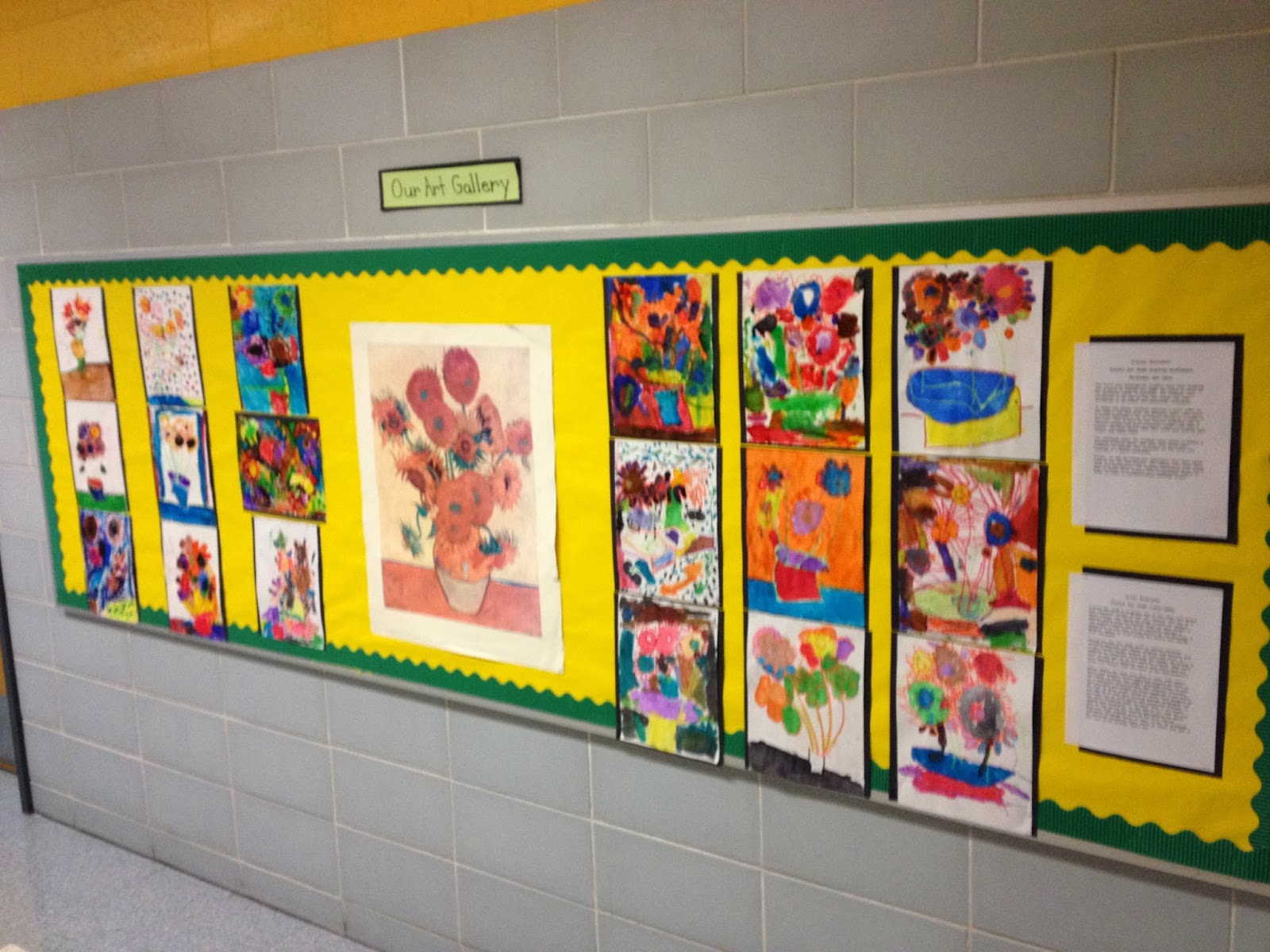
For this lesson, the students in Pre-K and Kindergarten were introduced to the artist Vincent Van Gogh. At this point of the school year, the kids know about line, shape and colors which we have been studying since September. Now, it is my goal to teach them how to combine these elements to make recognizable and meaningful work. The students began by watching a video about Van Gogh on Brainpopjr.com. Afterwords, they were read a book about his life and work. Now the demo's begin! I used oil pastel to show them how sunflowers can be drawn with circles and curved triangles for leaves. Next they used green to draw the stems, ovals and curved lines for the vase, and a horizontal line from side to side to create the table. This makes the picture grounded, so that the flowers are not "floating" on the page. The next day they are given a demo on basic watercolor technique and off to work they go! So uninhibited, they love the bright colors and easy access to numerous color choices. If they go over the lines, oh well, the oil pastel shapes still stay strong. Great job to the many artists! As certain children finish early, I handed out a floral coloring sheet by famous artist, Claude Monet who also worked with sunflowers in 1881! Enjoy!


![]()
Tuesday, January 14, 2014
Something Extra: Tour and Workshop at The Bronx Museum of Art
Throughout the last 5 years, The Bronx Museum of Art has been very good to the students at my school. They have given us many guided tours and workshops without the hefty price tag many other institutions require. The last two years we have been led through the museum by Ivan and Fatima, two exceptional guides. Last week I took 4 classes, which were separated into two groups. We were brought throughout the current exhibition which hosts two contemporary artists, Paulo Brusky and Tony Feher. Both of the artist's have amazing work, but the opportunity for the students to stop and interpret the meanings are priceless. They began with an introduction of "What is art, What is it good for?" led by Ivan. This was actually a question posed by Brusky during one of his performance pieces. The students had an opportunity to make a mixed media collage after the tour, which always makes them happy to come home with a prize! Enjoy the pictures and please take some time to visit this great museum, whether in person or online! Mac


Subscribe to:
Posts (Atom)