For this lesson, the time it took was much longer than anticipated! This should not surprise me, however, as this is often the case when working with detailed paintings around 30 kids! The first lesson was mostly instruction, lots of me talking and demonstrating. We looked at self-portraits by Van Gogh on the website Van Gogh'
s Gallery. It had a super cool video of many self-portraits he did that digitally melt into one another. Check it out if you can because its great to see the variety. We also looked at Picasso, then compared and contrasted the two artists. The emphasis was placed on how they drew what they "saw", from observation. The kids often associate self portraits with the whole body rather than the bust (head, neck, shoulders) that they will see in the mirror.
Next came the features of the face discussion which led us into my teacher demonstration. The kids have to see you do it first with any lesson. This not only inspires them, but they know what it is your looking for.
The first period ended with students drawing from their own personal mirrors (thank you Studio in a School!) with pencils.
The second period we focused on the environment that will be placed in the negative space around their bust. We offered either an abstract or representational background option after again looking at Van Gogh and Picasso online. Now the paint flows, which took plenty of time! I stuck with a light tone or dark tone and they could mix black and white as needed.
The next 2 periods were dedicated to work time. This led to a longer project, but better results! Hope you all enjoy their hard work...Mr. Mac
The digital platform for students to receive visual art instruction during the 2020 NYC school closing.
The Imagination Station Headquarters!
Friday, February 14, 2014
Thursday, January 23, 2014
1st and 2nd, Intro to Patterns/ Pattern Fish
Sadly, this year I only see one First grade and one Second grade one time a week...another words, 45 min a week! Trust me, that is not much time to work with them!
Soooo, this month we learned/reviewed patterns in nature. The students were introduced to ocean life through the non-fiction book Coral Reef and the fictional book The Rainbow Fish. Next, I gave a demo for them to understand how to create patterned fish like the ones we read about. They started by tracing a fish template, then cutting it out with scissors. Next, I showed them how to "block" off the parts of the fish using various line and shape patterns from the review. Next of course came color, being sure to create a very bright friend! After the first book and demo, they finished one patterned fish to take home. I popped a hole and added string for them to hang at home. The following week we read the next book, reveiwed the process and off to work they went. While they were working independently, I cut out a large blue sheet of paper for a mural. I used old scrap paper to whip up some colorful coral, then as they finished we taped them down with old faithful, mr. ductape. This way, they can take them back in the future. This is one of two animal patterned projects, so stay tuned!
PK-Kinder Jan. 2014: Van Gogh Sunflowers
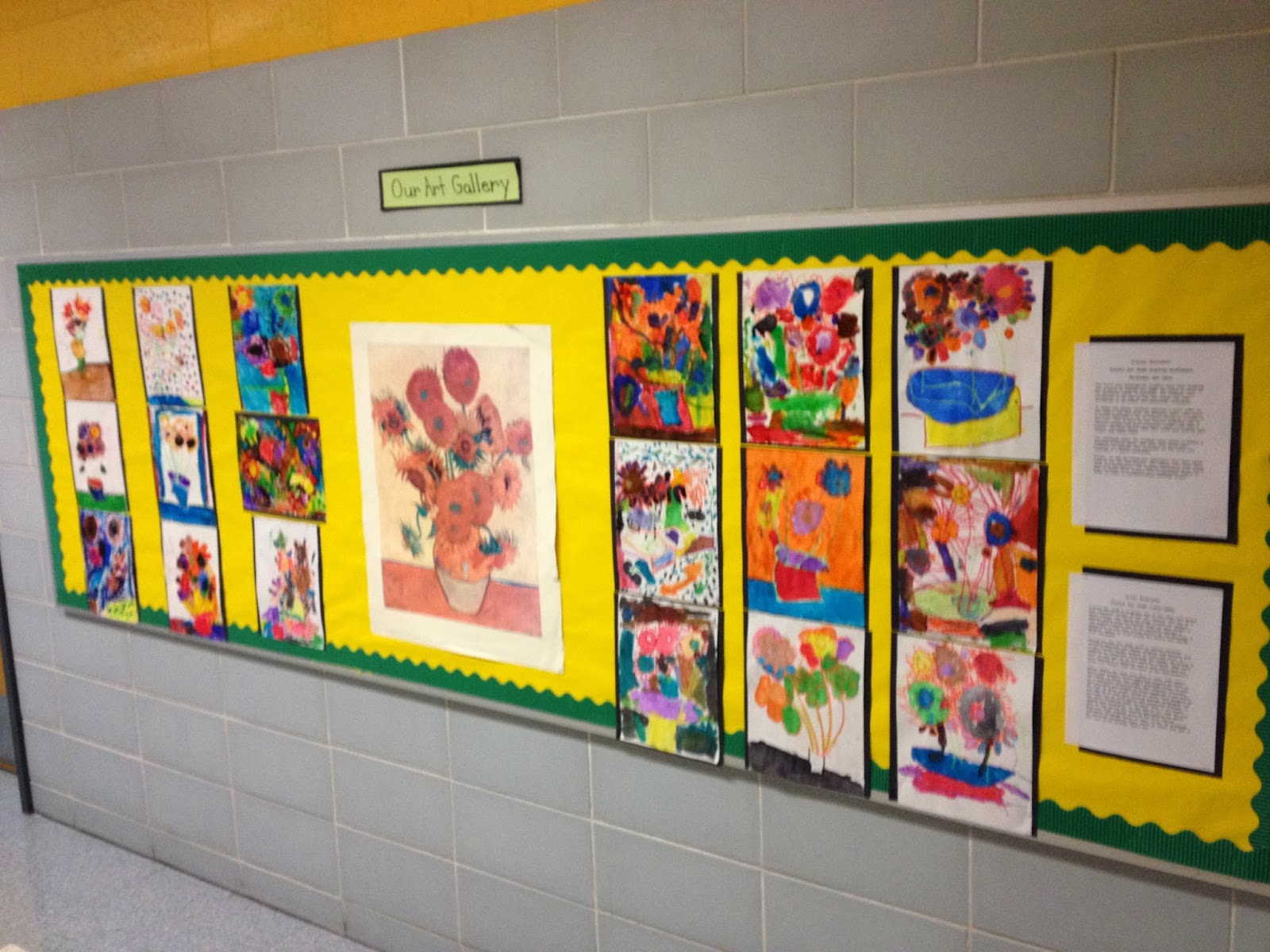
For this lesson, the students in Pre-K and Kindergarten were introduced to the artist Vincent Van Gogh. At this point of the school year, the kids know about line, shape and colors which we have been studying since September. Now, it is my goal to teach them how to combine these elements to make recognizable and meaningful work. The students began by watching a video about Van Gogh on Brainpopjr.com. Afterwords, they were read a book about his life and work. Now the demo's begin! I used oil pastel to show them how sunflowers can be drawn with circles and curved triangles for leaves. Next they used green to draw the stems, ovals and curved lines for the vase, and a horizontal line from side to side to create the table. This makes the picture grounded, so that the flowers are not "floating" on the page. The next day they are given a demo on basic watercolor technique and off to work they go! So uninhibited, they love the bright colors and easy access to numerous color choices. If they go over the lines, oh well, the oil pastel shapes still stay strong. Great job to the many artists! As certain children finish early, I handed out a floral coloring sheet by famous artist, Claude Monet who also worked with sunflowers in 1881! Enjoy!
Tuesday, January 14, 2014
Something Extra: Tour and Workshop at The Bronx Museum of Art
Throughout the last 5 years, The Bronx Museum of Art has been very good to the students at my school. They have given us many guided tours and workshops without the hefty price tag many other institutions require. The last two years we have been led through the museum by Ivan and Fatima, two exceptional guides. Last week I took 4 classes, which were separated into two groups. We were brought throughout the current exhibition which hosts two contemporary artists, Paulo Brusky and Tony Feher. Both of the artist's have amazing work, but the opportunity for the students to stop and interpret the meanings are priceless. They began with an introduction of "What is art, What is it good for?" led by Ivan. This was actually a question posed by Brusky during one of his performance pieces. The students had an opportunity to make a mixed media collage after the tour, which always makes them happy to come home with a prize! Enjoy the pictures and please take some time to visit this great museum, whether in person or online! Mac
Monday, December 16, 2013
Dec. 2013 Paul Klee Inspired Castles: 5th Grade
![]() |
| Paul Klee |
| Coolest 5th Graders, Ever... |
December: Color Theory PK-2nd
For the month of December, I focused on two main concepts throughout the grades. The first was color theory which is primary color mixing for PK-K. They go slow and steady throughout this month, focusing on only one secondary color per day (purple,green,orange). The books that I read all have to do with color mixing such as Little Blue and Little Yellow, Mouse Paint, The Color Tree and Is it red?Is it yellow?Is it Blue? The idea is just to expose them to the concepts and make sure they adhere to painting rules of clean brush and not mixing everything! They learn to separate the piles of primary between mixable and leave it alone! This will give them more colors to choose from during paint time. We focused on putting shapes together to make a city scape, much like a puzzle now. They were given a demonstration, then examples are left on the table during work time. The first day not too great, but by the third and final period they were really starting to get it!
The 1st and 2nd Grade worked with the color wheel and mixing all 3 primary colors at the same time. They were asked to create the pizza with templates and rulers, then fill in the correct colors on the color wheel. I have 5th graders now that still remember doing this 4 years ago. The color wheel is referenced often for lessons on complementary colors, warm and cool colors and mixing primary colors. It is useful for them to learn this early! They also began cityscapes, focused more on overlapping the buildings to produce depth. They had to use all 6 colors on the plate while of course washing the brush.Enjoy!
Tuesday, December 3, 2013
Nov. Pk-K Collage Techniques: Funny Faces and artist Eric Carle!
For the month of Nov., the youngest students in PK-K were taught basic collage techniques. They used scissors and glue to arrange the shapes into realistic pictures. The first project was about the features of the face. The students were taught to overlap and layer the pieces so create the face, then add a pattern using lines around their artwork. This lesson had many priciples of design, elements of art and important techniques that will serve them well for their artistic careers!
The next lesson was using Eric Carle's book The Very Hungry Cattepillar. They used precut shapes to arrange the cattepillar on the tree limb, being sure to create a pattern again for reinforcement of previous lessons. The students saw a video on several Eric Carle stories, then I read the book to them. They sure enjoyed it! Mr. Mac
Subscribe to:
Posts (Atom)